
Elon Musk's Moonbase Alpha Plan: SpaceX and xAI Merge to Build Lunar AI Manufacturing Facility in 2026:
"Join xAI if the idea of mass drivers on the Moon appeals to you," CEO Elon Musk proclaimed yesterday following a major restructuring that saw a stream of former executives exit the AI lab. This bold recruitment pitch comes at a pivotal moment for the newly merged SpaceX-xAI entity as it prepares for one of the most anticipated IPOs in tech history.
From Mars Dreams to Moon Reality: Musk's Strategic Pivot:
This is an interesting recruitment strategy after the company's merger with Musk's rocket maker, SpaceX, and the combined company's anticipated public offering. You might think that xAI employees ought to be fascinated with achieving artificial general intelligence (AGI), using deep learning models to disrupt traditional software companies, or simply bad wordplay like "Macrohard." But instead, Elon Musk is redirecting the entire organization's vision toward an ambitious lunar future.
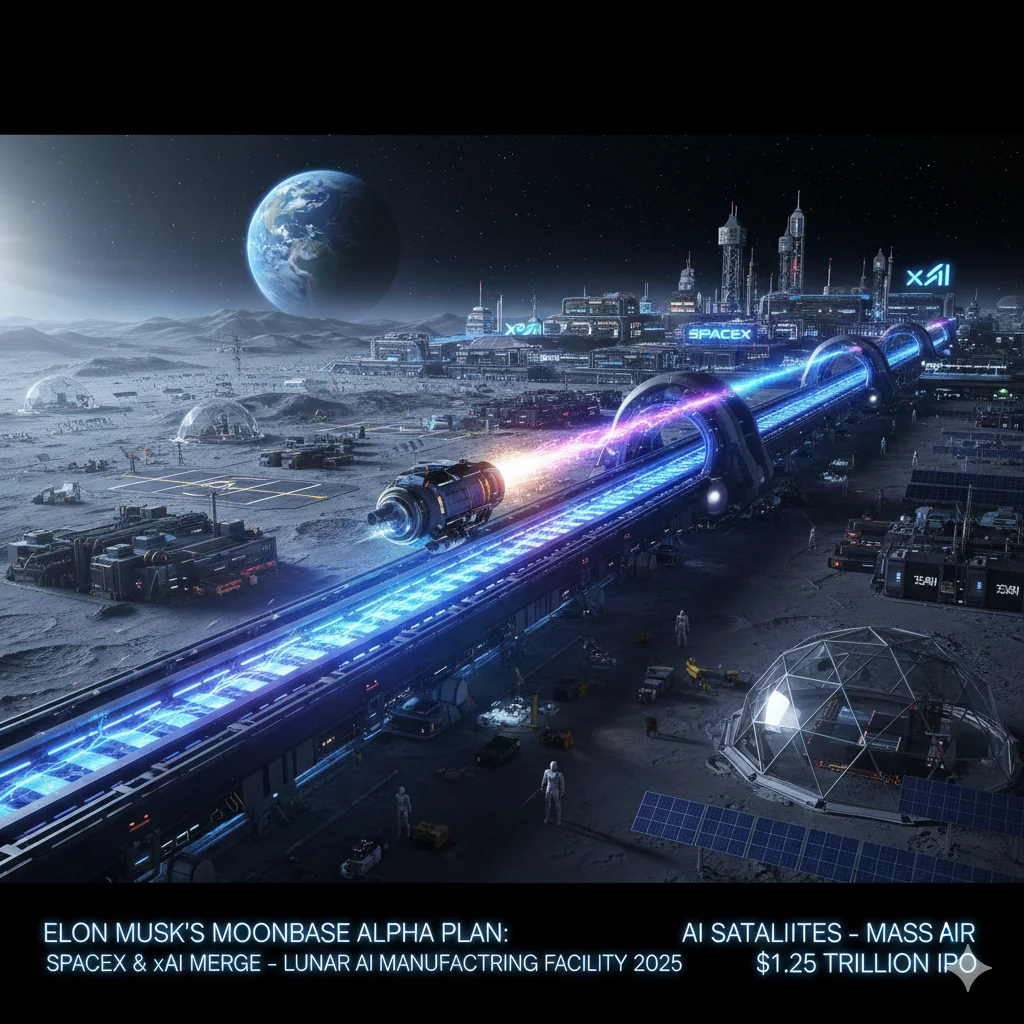
After outlining plans to build AI data centers in orbit—the primary synergy between SpaceX and xAI—Musk took the idea even further during the all-hands meeting. "What if you want to go beyond a mere terawatt per year?" Musk asked his assembled employees. "To do that, you have to go to the moon…I really want to see a mass driver on the moon that is shooting AI satellites into deep space."
Understanding the Moonbase Alpha Vision: AI Satellites Launched from Lunar Surface:
In Musk's telling, the step beyond data centers orbiting Earth is even larger computers positioned in deep space. And furthermore, Musk says the best way to achieve that ambitious goal is to build a self-sustaining city on the moon capable of manufacturing space computers and hurling them into the solar system using a massive electromagnetic mass driver—essentially a giant maglev train designed to launch payloads into space.
If that all feels a bit much, veteran Musk watchers know there's a revealing clue about where this discussion appears in the video of the all-hands meeting that xAI shared with the public. The slide describing the moon base comes at the very end of the presentation deck, where, during SpaceX pep talks, Musk typically shares dramatic renderings of SpaceX rockets landing on Mars and waxes rhapsodic about the future of multi-planetary humanity.
Notably, the moon base announcement comes just after SpaceX has publicly backed away from its long-held goal of colonizing Mars—a vision that defined the company for nearly a decade. Now, with xAI in the corporate fold, Musk needs a new science fiction metaphor for the future.
The Kardashev Scale: Musk's New Framework for Galactic Civilization:
Enter the Kardashev Scale, a theoretical measure of galactic civilizations coined by Soviet astronomer Nikolai Kardashev in the 1960s. The concept provides a framework for understanding civilization advancement based on energy usage. Early civilizations figure out how to leverage all the power sources on their planets (Type I), then advance to harnessing the energy of their star (Type II), and eventually entire galaxies (Type III).
With the moon base, Musk says the company could harness "maybe even a few percent of the sun's energy" to train and operate increasingly powerful AI models. "It's difficult to imagine what an intelligence of that scale would think about," he told his staff during the presentation, "but it's going to be incredibly exciting to see it happen."
Why Mars Failed: The Economic Reality Behind the Pivot:
In the nine years since Musk unveiled his plan for Martian exploration and colonization, the vision proved to be an effective hiring tool for SpaceX. The founding tale of Musk's interest in the Red Planet offered a long-term vision that united the company's various development efforts and signaled the company's ambition among other space contractors that settled for incremental work on government priorities. "Occupy Mars" t-shirts offered a visible symbol of SpaceX's aspirations and became iconic in tech culture.
That's where the hypothetical moon base fits in—part of a long history of Musk wrapping his companies in powerful narratives that inspire employees and capture public imagination. It's the same storytelling approach that promised one million people living on Mars, but now pivoting to cater to a future where artificial intelligence is the most interesting technological frontier.
Martian mission creep became apparent in Musk's May 2025 Starship update, when the presentation ended with a now-cancelled vision of Tesla Optimus robots clomping across the Red Planet—a concept that never gained traction with investors or NASA.
The Business Problem: Nobody Would Pay for Mars:
There was just one fundamental problem with SpaceX and Mars: No one wanted to pay them to go there. Plans announced in 2016 to repurpose the company's Dragon spacecraft as a Mars lander were quietly abandoned the next year after the technical challenges became too costly and no customers emerged.
Since Musk unveiled the vehicle that would become Starship in 2016, its capabilities, initially intended for Mars colonization, have been systematically scaled back to focus on two more remunerative tasks: launching satellites for the Starlink communications network and fulfilling $4 billion worth of contracts to land astronauts on the moon for NASA's Artemis program.
The Economic Case for Lunar AI Manufacturing:
Unlike a multi-planetary civilization dream, there may actually be some business logic in having SpaceX purchase a money-burning AI startup and social media platform to build data centers in Earth orbit, particularly if forecasts of rising computational demand and energy costs on the ground come true. Industry experts suggest that orbital data centers might become economically viable in the 2030s.
The lunar manufacturing concept takes this idea several steps further. Rather than simply placing data centers in orbit around Earth, Musk envisions utilizing the moon's resources and unique environment to manufacture AI computing infrastructure that can then be launched deeper into space using electromagnetic mass drivers.
The Technical Challenges: What Needs to Happen First:
Hypothetically, building satellites on the moon would require a lot more of Musk's other ambitious dreams coming true first. Scientists and startups are currently experimenting with building chips and other precision components in microgravity environments. But mass-producing many tons of advanced computers on the lunar surface presents extraordinary challenges.
This vision requires a universe where:
-
It is dramatically cheaper to get to space than current launch costs—the central requirement for making any lunar manufacturing economically feasible.
-
All the raw materials for computer manufacturing can either be extracted from lunar regolith or transported from Earth economically.
-
A "self-sustaining city" exists on the moon with the infrastructure, power generation, and life support systems necessary to support manufacturing operations.
-
Advanced robotics and automation can handle the complex precision work required for chip fabrication and satellite assembly in the moon's low-gravity environment.
The Recruitment Strategy: Selling the Vision to Engineers:
In a sense, that's the entire point of Moonbase Alpha: This is the stretch goal that gives xAI employees something unique and inspiring to work toward. If meme-happy retail investors buy into the argument during the anticipated IPO, they could potentially turn SpaceX shares into the next Tesla—a company whose valuation often defied traditional metrics based on the power of Musk's vision.
The engineers—whether AI specialists or aerospace professionals—who Musk needs to achieve his goals may find the shift from Mars to Moon jarring. For years, SpaceX employees rallied around the Mars colonization dream. Now they're being asked to embrace a new vision centered on lunar AI manufacturing.
Why This Narrative Matters: Differentiating xAI from Competitors:
The vision is one way to explain what xAI is about, other than being just another large language model provider—perhaps best known publicly for Grok's controversial lack of content moderation. As one of the company's departing executives said on his way out the door, "all AI labs are building the exact same thing, and it's boring."
This critique highlights a real problem in the artificial intelligence industry: most major AI labs are pursuing remarkably similar approaches, training ever-larger language models on ever-more data, competing primarily on incremental improvements in capabilities and slightly different corporate philosophies around safety and openness.
The Power of an Audacious Vision in Tech Recruiting:
Mass-producing a solar system-scale supercomputer on the moon is many things—critics will undoubtedly use words like "insane" or "unrealistic"—but it is decidedly not the exact same thing every other AI company is doing, and it is absolutely not boring.
For top engineering talent deciding between job offers, the choice between optimizing existing AI models at a conventional lab versus working toward building a lunar manufacturing facility that launches AI satellites into deep space using electromagnetic mass drivers presents a stark contrast. Musk is betting that the more audacious vision will attract the kind of ambitious, unconventional thinkers he needs.
The IPO Question: Will Investors Buy the Moon Dream?:
The real test of Moonbase Alpha comes when SpaceX-xAI goes public in what could be one of the largest tech IPOs in history. Will public market investors—who must balance visionary potential against financial reality—embrace a company whose CEO is promising to build cities on the moon to manufacture AI satellites?
Tesla's success provides a potential roadmap. Despite years of production delays, cash flow challenges, and missed targets, Tesla maintained a premium valuation largely because investors believed in Musk's vision of accelerating the world's transition to sustainable energy. The same narrative power could theoretically work for SpaceX-xAI.
The Competitive Landscape: xAI vs. OpenAI, Anthropic, and Google:
In the terrestrial AI race, xAI competes with well-funded rivals like OpenAI, Anthropic, and Google's DeepMind. These competitors have deeper AI research expertise, larger datasets, more enterprise partnerships, and in some cases, more advanced models. What they don't have is a rocket company capable of actually building space infrastructure.
The SpaceX merger gives xAI a unique positioning that no competitor can easily replicate. While OpenAI talks about artificial general intelligence and Anthropic emphasizes AI safety, xAI can point to plans for orbital data centers and lunar manufacturing facilities—backed by the only company that's proven it can land and reuse orbital rockets.
The Timeline: When Could Moonbase Alpha Actually Happen?:
Musk has not provided a specific timeline for the Moonbase Alpha concept, which is telling in itself. Even for someone known for optimistic schedules, promising a specific date for a self-sustaining lunar city capable of manufacturing and launching AI satellites would strain credulity.
Realistic estimates from space industry analysts suggest that even with aggressive development, a basic lunar outpost capable of supporting long-term habitation might be possible in the 2030s. Adding manufacturing capability for advanced electronics would push the timeline further. A fully operational mass driver launching AI satellites into deep space? That's likely a 2040s or 2050s proposition at the earliest.
What This Means for the Future of Space Exploration:
Regardless of whether Moonbase Alpha ever materializes, the announcement signals an important shift in how private space companies are thinking about lunar development. Rather than viewing the moon primarily as a destination for scientific exploration or a stepping stone to Mars, Musk is framing it as critical industrial infrastructure for humanity's technological future.
This industrial approach to lunar development could attract different types of investment and partnership than pure exploration missions. Companies interested in the future of AI computing, energy generation, or advanced manufacturing might see value in lunar infrastructure in ways that Mars colonization never quite achieved.
Conclusion: The Moon as Musk's New Unifying Vision:
Elon Musk has always understood the power of narrative. Tesla wasn't just an electric car company—it was accelerating the world's transition to sustainable energy. SpaceX wasn't just a rocket manufacturer—it was making humanity multi-planetary. Now, with xAI merged into SpaceX, the company needs a new story that ties together artificial intelligence, space exploration, and Musk's vision of humanity's technological future.
Moonbase Alpha provides that narrative. It's audacious enough to inspire ambitious engineers, grounded enough in actual SpaceX capabilities to seem plausible, and different enough from what competitors are doing to give xAI a unique positioning in the crowded AI market.
Whether Moonbase Alpha ever becomes reality is almost beside the point. The vision serves its purpose if it helps SpaceX-xAI recruit top talent, excite retail investors during the IPO, and differentiate the company in an AI industry where everyone is otherwise "building the exact same thing."
As Musk himself suggested, it's difficult to imagine what an intelligence powered by "a few percent of the sun's energy" would think about. But for now, what matters is what talented engineers, potential employees, and future investors think about the idea—and whether they're inspired enough by the vision to join the journey.
One thing is certain:In the battle for narrative supremacy in the AI industry, Elon Musk just made his move. While competitors optimize their language models, xAI is aiming for the moon—literally.
Support our research
Independent analysis fueled by you.