
Carbon Robotics Unveils Large Plant Model, an AI System That Identifies and Eliminates Weeds Instantly.
Artificial intelligence is rapidly transforming agriculture, and Carbon Robotics has taken a major step forward with the launch of a new AI model designed to change how farmers manage weeds.
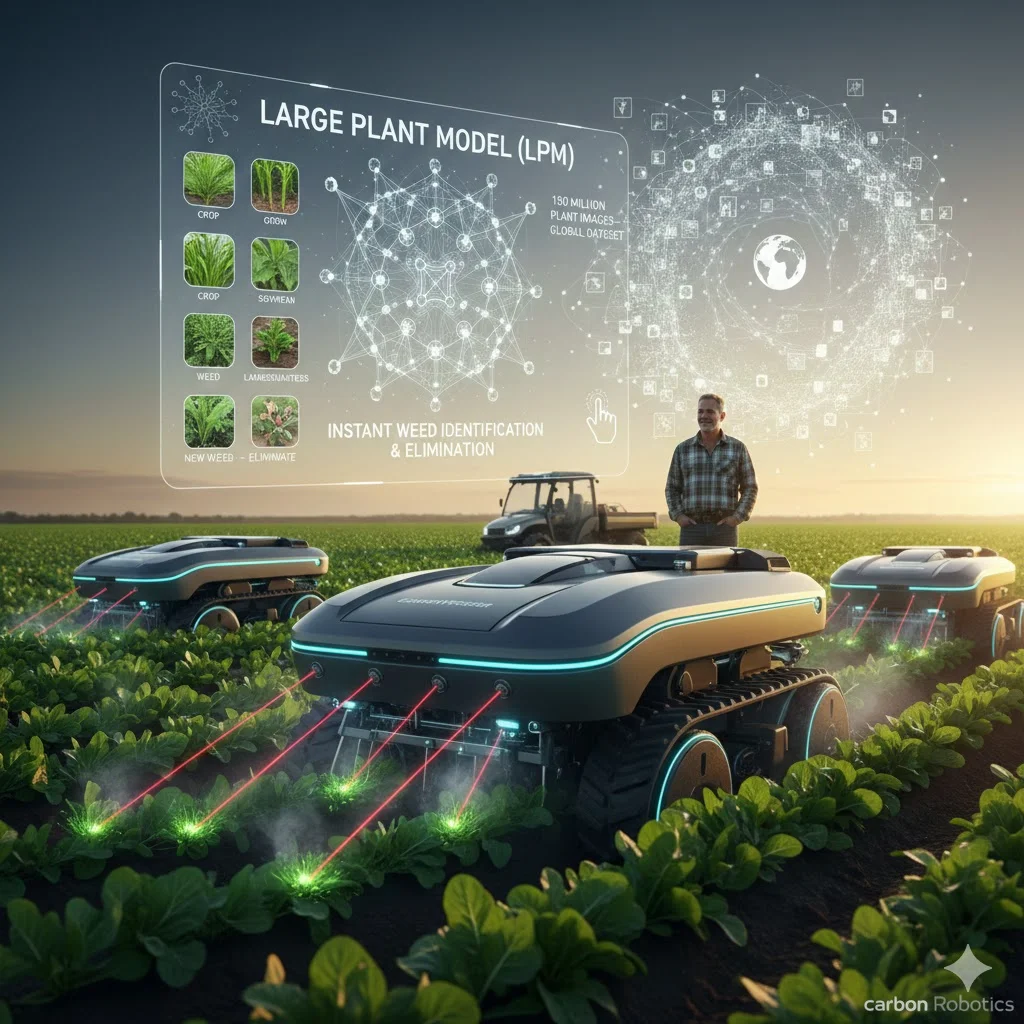
The Seattle-based agritech company, best known for its autonomous LaserWeeder robots, has introduced the Large Plant Model (LPM)—an advanced AI system that can detect, identify, and classify plant species in real time.
The breakthrough eliminates one of the biggest challenges in precision agriculture: teaching machines to recognize new weeds as they appear in the field. With LPM, farmers can now identify and eliminate unfamiliar weeds instantly, without the need for time-consuming retraining or manual data labeling.
How Carbon Robotics’ AI Sees Plants Like a Farmer:
Traditionally, determining what is a crop and what is a weed has relied on the trained eye of a farmer. Different soil conditions, weather patterns, growth stages, and lighting can all change how a plant looks, making automation extremely difficult.
Carbon Robotics’ Large Plant Model bridges that gap by giving machines a deeper understanding of plant biology. Instead of memorizing fixed images, LPM learns plant structure, relationships, and species-level characteristics, allowing it to generalize across environments.
This model now powers Carbon AI, the intelligence system at the core of the company’s autonomous weed-killing robots, which use precision lasers to destroy weeds without chemicals.
Trained on 150 Million Plant Images Across the Globe:
One of LPM’s greatest strengths is the sheer scale of its training data.
According to Carbon Robotics, the model has been trained on more than 150 million photos and plant data points, collected directly from LaserWeeder robots operating on over 100 farms in 15 countries. This real-world data gives the AI exposure to countless plant variations across:
- Soil types.
- Climate zones.
- Crop stages.
- Lighting and seasonal conditions.
As a result, LPM can identify plants it has never seen before, something that was previously impossible with traditional agricultural AI systems.
No More Retraining When New Weeds Appear:
Before the introduction of LPM, Carbon Robotics faced a major bottleneck.
Founder and CEO Paul Mikesell explained that whenever a new weed appeared—or even when an existing weed looked slightly different—the company had to manually label new data and retrain its models. This process typically took around 24 hours per update, slowing down response time for farmers. With the Large Plant Model, that limitation disappears.
Now, farmers can simply select an image of a new weed from the robot’s interface and tell the system to eliminate it—instantly.
“There’s no new labeling or retraining,” Mikesell said. “The Large Plant Model understands, at a much deeper level, what it’s looking at.”
Built by Experts With Deep AI Experience:
Carbon Robotics was founded in 2018, and the development of LPM began shortly after the company shipped its first machines in 2022. Mikesell brings extensive experience in neural network development, having previously worked at Uber and on Meta’s Oculus VR headsets. That background helped shape LPM into something closer to a foundation model for plants, rather than a narrow classification system.
Seamless Software Update for Existing Farmers:
The new AI model will roll out to existing customers through a software update, requiring no hardware changes. Once updated, farmers can:
-
Review plant images captured by the robots:
-
Choose which plants to protect and which to destroy.
-
Adapt weed control strategies in real time.
This flexibility is especially important as weed populations evolve and new invasive species spread due to climate change.
Backed by Major Investors and Built to Scale:
Carbon Robotics has raised more than $185 million in venture capital, with backing from major investors including:
-
Nvidia NVentures.
-
Bond.
-
Anthos Capital.
The company plans to continue refining the Large Plant Model as more data flows in from its global robot fleet, making the system smarter with every field it visits.
“We now have enough data to look at almost any image and determine what kind of plant it is,” Mikesell said.
The Future of Weed Control Is AI-Driven and Chemical-Free:
By combining AI-powered plant identification with laser-based weed elimination, Carbon Robotics is offering farmers a powerful alternative to herbicides. The Large Plant Model represents a major leap toward:
-
Sustainable agriculture.
-
Reduced chemical use.
-
Higher crop yields.
-
Real-time farm automation.
As AI models like LPM continue to evolve, the role of farmers may shift from manual weed control to high-level decision-making, guided by intelligent machines that understand the field almost as well as humans do.
Support our research
Independent analysis fueled by you.