
India's AI Infrastructure Boom 2026: How Power Solutions and GPU Scaling Are Reshaping Data Centers:
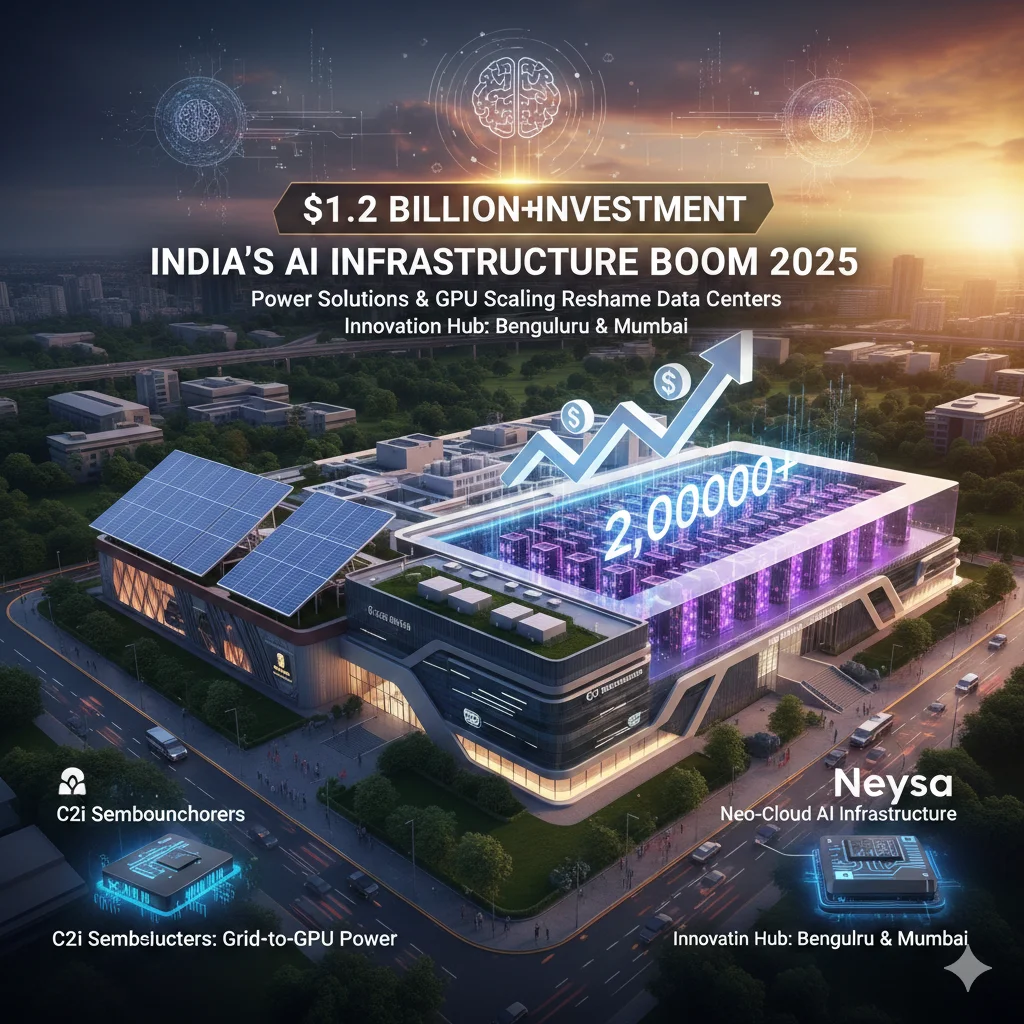
The artificial intelligence revolution is creating unprecedented demands on data center infrastructure, and India is emerging as a critical player in solving two of the industry's most pressing challenges: power efficiency and GPU capacity. Recent investments totaling over $1.2 billion signal that global investors recognize India's potential to become a major hub for AI infrastructure innovation.
The Power Bottleneck in AI Data Centers:
As AI workloads continue to expand, power consumption has become the primary limiting factor for scaling data centers. The numbers tell a striking story: electricity consumption from data centers is projected to nearly triple by 2035, while data-center power demand could surge 175% by 2030 from 2023 levels—equivalent to adding another top-10 power-consuming country to the global grid.
C2i Semiconductors: Revolutionizing Power Delivery for AI:
Addressing this critical bottleneck, C2i Semiconductors, a Bengaluru-based startup, has raised $15 million in Series A funding led by Peak XV Partners. The company is developing innovative plug-and-play, system-level power solutions specifically designed for AI data centers.
The challenge C2i tackles is substantial: high-voltage power must be stepped down thousands of times before reaching GPUs, currently wasting 15% to 20% of energy in the conversion process. Founded in 2024 by former Texas Instruments power executives, C2i is redesigning power delivery as a single, integrated "grid-to-GPU" system.
By treating power conversion, control, and packaging as an integrated platform, C2i estimates it can cut end-to-end losses by approximately 10%—saving roughly 100 kilowatts for every megawatt consumed. These efficiency gains translate directly into reduced cooling costs, improved GPU utilization, and better overall data-center economics.
The startup's approach addresses one of the most entrenched parts of the data-center stack, long dominated by large incumbents. With a team of about 65 engineers, C2i expects its first two silicon designs to return from fabrication between April and June, when the company plans to validate performance with data-center operators and hyperscalers.
India's GPU Infrastructure Revolution:
While C2i focuses on power efficiency, Neysa is addressing another critical piece of the AI infrastructure puzzle: GPU capacity. The Mumbai-headquartered startup has secured up to $1.2 billion in combined equity and debt financing, with Blackstone taking a majority stake through a $600 million primary equity investment.
The Neo-Cloud Opportunity:
Neysa operates in the emerging "neo-cloud" segment, providing dedicated GPU-first infrastructure for enterprises, government agencies, and AI developers. This model has gained traction as demand for AI computing surges globally, creating supply constraints for specialized chips and data center capacity.
India currently has fewer than 60,000 GPUs deployed, but this figure is expected to scale nearly 30 times to more than two million in the coming years. This expansion is driven by government demand, enterprises in regulated sectors requiring local data storage, and AI developers building models within India.
Neysa currently operates about 1,200 GPUs and plans to deploy more than 20,000 GPUs over time. The startup aims to more than triple its capacity and revenue next year as demand for AI workloads accelerates.
Why India Is Positioned for AI Infrastructure Leadership:
India's emergence as an AI infrastructure hub reflects the maturation of its semiconductor design ecosystem. The country boasts deep engineering talent, with a growing share of global chip designers based in India. Government-backed design-linked incentives have lowered the cost and risk of tape-outs, making it increasingly viable for startups to build globally competitive semiconductor products from India.
The combination of talent, cost advantages, and supportive government policies has created what investors describe as an "e-commerce in 2008" moment for semiconductors in India—an industry just getting started with enormous growth potential.
The Economic Impact of AI Infrastructure Innovation:
For data center operators, energy costs become the dominant ongoing expense after the initial capital investment in servers and facilities. Even incremental efficiency gains carry enormous value—potentially saving tens of billions of dollars across the industry.
Similarly, the expansion of local GPU capacity addresses critical needs around data sovereignty, latency reduction, and customization that traditional hyperscalers often struggle to meet. Enterprises in regulated sectors such as financial services and healthcare particularly value the ability to keep data local while accessing cutting-edge AI infrastructure.
Looking Ahead: Execution and Validation:
Both C2i and Neysa face the critical test of execution. For C2i, the coming six months will be crucial as the company validates its silicon designs and begins working with early customers. For Neysa, scaling from 1,200 to 20,000+ GPUs while maintaining service quality and customer satisfaction will be the key challenge.
What's clear is that India is no longer just a destination for captive design centers or back-office operations. The country is building globally competitive products that address fundamental challenges in AI infrastructure—from power efficiency at the chip level to large-scale GPU deployment at the data center level.
As AI continues to reshape every industry, the innovations emerging from India's startup ecosystem could play a decisive role in determining how efficiently and sustainably the world scales its AI capabilities.
With over $1.2 billion in fresh capital backing these ventures, investors are betting that India's combination of technical talent, cost structure, and market opportunity will deliver the next generation of AI infrastructure solutions.
Support our research
Independent analysis fueled by you.