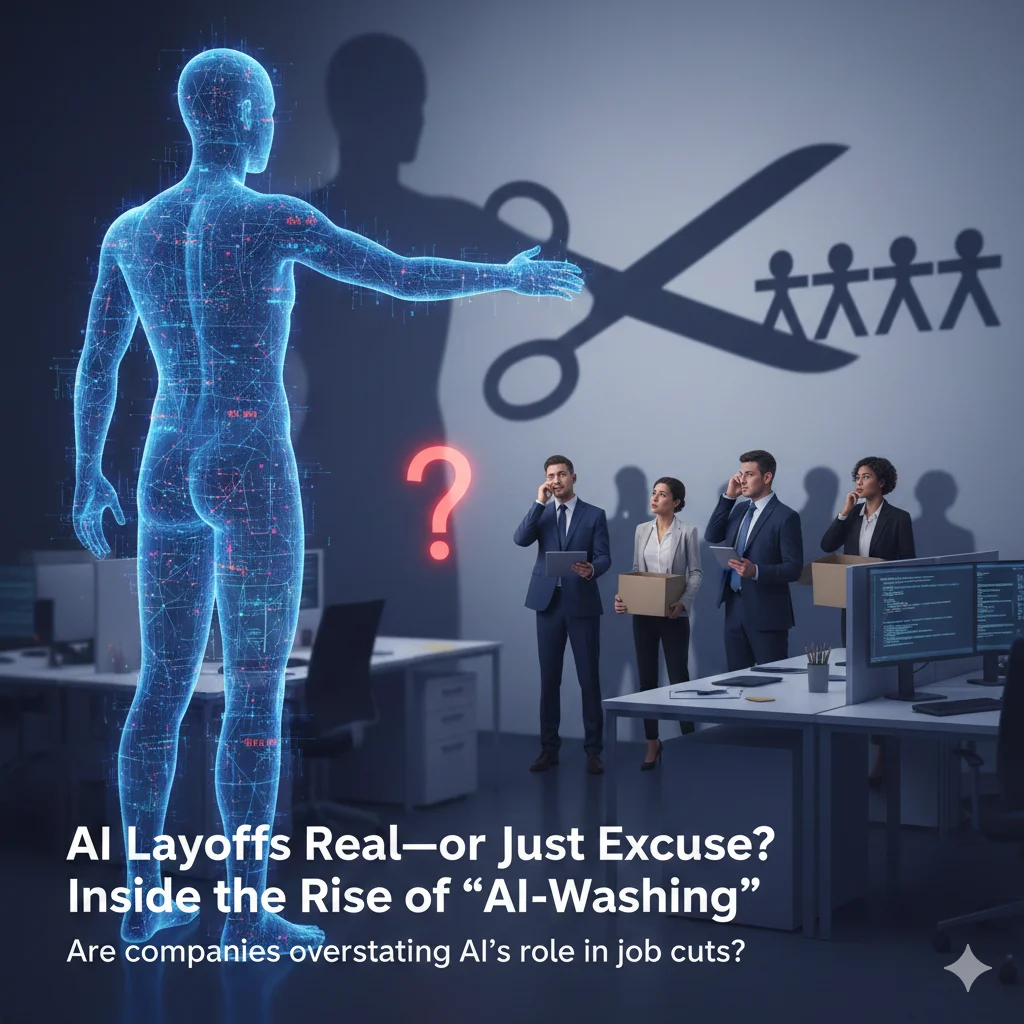

Artificial intelligence is rapidly transforming how companies operate—
But is AI truly responsible for the wave of layoffs sweeping through the tech industry, or is it being used as a convenient cover for deeper business problems? This question is at the center of a growing debate around a phenomenon now known as “AI-washing.”
In recent months, dozens of major companies have cited artificial intelligence as the primary reason for workforce reductions. According to public disclosures, more than 50,000 layoffs in 2025 were officially attributed to AI-driven efficiency gains. High-profile names like Amazon and Pinterest have openly stated that automation and AI tools played a role in recent job cuts. However, a closer look suggests the reality may be far more complex.
What Is AI-Washing?
The term AI-washing refers to companies overstating or misrepresenting the role of artificial intelligence in business decisions—particularly layoffs—to make those decisions appear more strategic, innovative, or future-focused than they actually are. Instead of admitting to financial pressure, slowing growth, or over-hiring during the pandemic, organizations may frame layoffs as part of an AI transformation strategy.
A New York Times investigation highlights this growing trend, questioning how many companies are genuinely restructuring their workforce around mature AI systems—and how many are simply using AI as a convenient narrative.
Are Companies Really Ready for AI-Driven Workforces?
A Forrester report published in January 2025 raises serious doubts about the legitimacy of many AI-related layoff claims. According to the report, most companies announcing AI-driven job cuts do not yet have fully developed, vetted, or scalable AI applications capable of replacing human roles at the scale implied.
Forrester analysts argue that this disconnect strongly suggests AI-washing, stating that many layoffs are financially motivated cost-cutting measures, not the result of genuine AI implementation.
Why Blaming AI Appeals to Investors:
Experts say there’s a strategic reason companies lean into the AI narrative. Molly Kinder, senior research fellow at the Brookings Institution, explains that attributing layoffs to artificial intelligence sends a powerful signal to investors.
Calling layoffs “AI-driven” suggests innovation, efficiency, and long-term competitiveness. In contrast, admitting that cuts stem from declining revenue, poor forecasting, or post-pandemic corrections can alarm shareholders.
As Kinder notes, framing layoffs around AI is a “very investor-friendly message,” especially when the alternative is acknowledging that the business itself is struggling.
The Human Cost of the AI Narrative:
While AI adoption is inevitable across industries, critics warn that exaggerating its role in layoffs can have serious consequences. Workers may feel displaced by technology that isn’t actually in place, while policymakers and the public receive a distorted picture of AI’s real impact on employment.
Moreover, AI-washing risks undermining trust. If companies continue to cite artificial intelligence as a justification without delivering meaningful innovation, both employees and investors may become increasingly skeptical of corporate AI claims.
The Bottom Line:
There’s no doubt that artificial intelligence is reshaping the future of work—but not all AI layoffs are what they seem. As 2025 unfolds, the challenge will be separating genuine AI-driven workforce transformation from AI-washing used to mask financial or strategic missteps.
For employees, investors, and regulators alike, understanding the difference has never been more important.
Support our research
Independent analysis fueled by you.