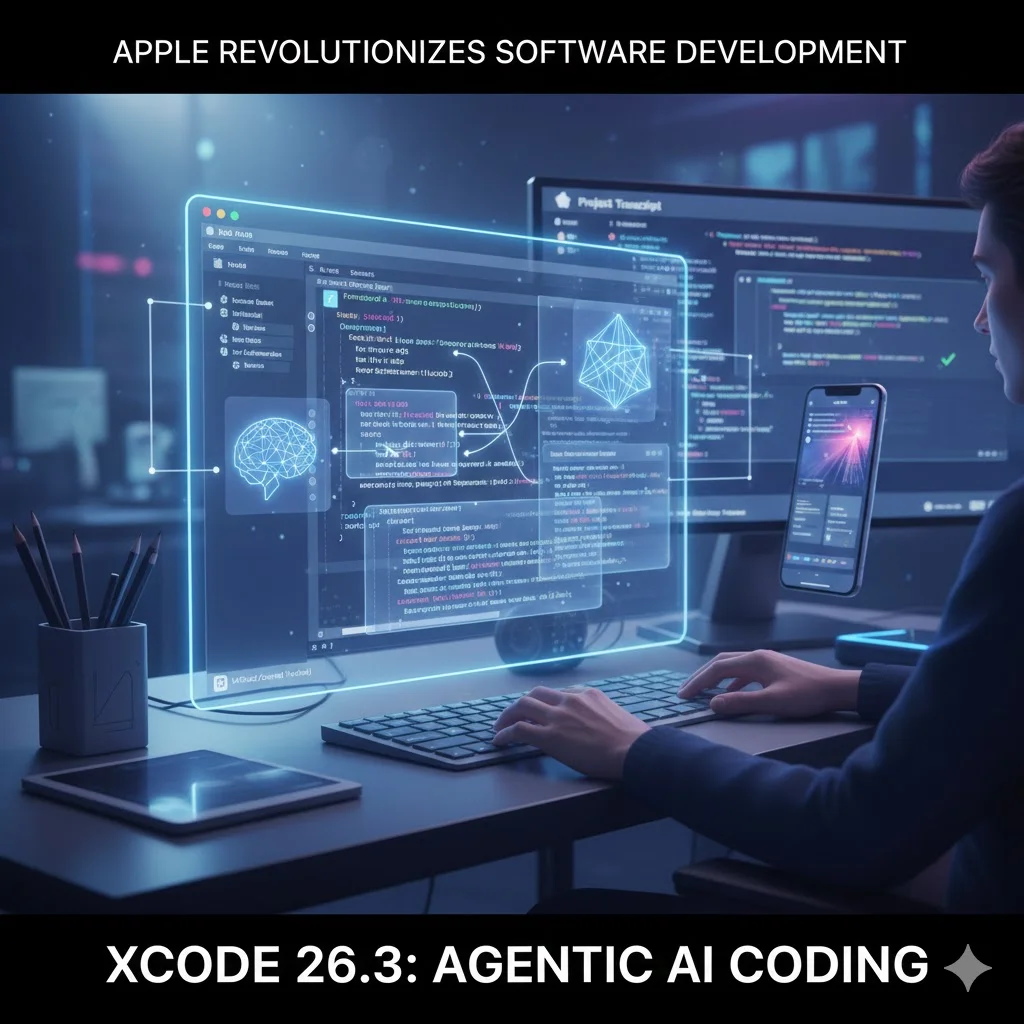

Apple has officially entered the agentic AI coding era with the groundbreaking release of Xcode 26.3,
fundamentally transforming how developers build applications across the entire Apple ecosystem. This major update introduces deep integrations with leading AI platforms OpenAI and Anthropic, marking a pivotal moment in AI-powered software development.
The Dawn of Agentic Coding in Xcode:
The Xcode 26.3 Release Candidate is now available to all Apple developers through Apple's developer website, with a broader App Store rollout expected shortly. This release represents far more than incremental improvements—it's a complete reimagining of the integrated development environment (IDE) for the age of artificial intelligence.
Developers can now leverage advanced AI agents directly within Xcode to build apps for iPhone, iPad, Mac, Apple Watch, and other Apple platforms. This seamless integration brings autonomous AI coding capabilities to millions of developers worldwide.
From AI Assistance to True Autonomous Development:
While Xcode 26, released last year, introduced ChatGPT and Claude support for code suggestions and conversational assistance, Xcode 26.3 takes a quantum leap forward. The new version enables true agentic coding through Anthropic's Claude Agent and OpenAI's Codex, allowing AI models to perform complex, multi-step development tasks autonomously.
Unlike traditional AI coding assistants that respond to isolated prompts, these agentic AI tools can:
- Explore entire project structures and understand metadata.
- Write and modify code across multiple files.
- Build projects and run comprehensive tests.
- Identify and fix errors automatically.
- Execute complex workflows without constant human intervention.
Deep Integration with Xcode's Core Architecture:
The agentic AI integration in Xcode 26.3 provides AI models with unprecedented access to Xcode's internal tooling and workflows.
This deep integration enables sophisticated automation capabilities, including:
-
File Management:Autonomous creation, modification, and organization of project files.
-
Project Discovery: Intelligent navigation through complex codebases.
-
Code Previews: Real-time visualization of changes before implementation.
-
Test Execution: Automated testing and validation workflows.
-
Documentation Access: Direct - integration with Apple's latest developer documentation.
This documentation access is particularly crucial, ensuring AI agents use current APIs and follow Apple's recommended best practices, significantly reducing deprecated method usage and framework errors.
MCP: The Foundation of Flexible AI Integration:
Apple's implementation leverages the Model Context Protocol (MCP), creating a standardized interface between Xcode and external AI agents. This architecture positions Xcode as a model-agnostic platform, meaning developers aren't locked into specific AI providers.
Any MCP-compatible AI model can theoretically integrate with Xcode for tasks including project modifications, documentation lookup, file editing, and preview generation. This flexibility aligns Apple with industry trends favoring developer choice and extensibility.
Getting Started with Agentic AI Coding:
Implementing agentic coding in Xcode is straightforward:
-
Download AI Agents: Access preferred agents directly from Xcode settings.
-
Authentication: Connect accounts using sign-in or API keys.
-
Model Selection: Choose specific versions like GPT-5.2 Codex or GPT-5.1 mini from a built-in dropdown menu.
-
Natural Language Prompts: Describe desired features or modifications through an intuitive prompt interface.
The agent then breaks complex tasks into visible, trackable steps, searching documentation, planning implementation strategies, and executing code changes with full transparency.
Transparency, Control, and Safety First:
Apple has prioritized developer control throughout the agentic coding experience. Every agent action is visible through visual code highlights and comprehensive project transcripts, allowing developers to understand exactly what changes are being made and why.
After completing tasks, agents automatically build projects and run tests to verify functionality. If issues arise, agents can iterate independently to resolve errors and optimize performance.
Critical Safety Features:
-
Automatic milestone creation after each agent-driven change.
-
Complete project rollback capability to any previous state.
-
Transparent decision-making processes.
-
Structured reasoning through pre-planning prompts.
Empowering Developers at Every Level:
Apple positions agentic AI coding as valuable for both experienced developers seeking efficiency and beginners learning best practices. New developers particularly benefit from understanding not just what code is written, but why specific approaches are chosen. To support adoption, Apple is hosting a code-along workshop on its developer website, enabling hands-on learning with real-time guidance.
The Future of Apple Software Development:
By deeply integrating OpenAI and Anthropic into Xcode 26.3, Apple signals that AI-driven development is now central to its platform strategy. Rather than replacing developers, agentic coding aims to:
-
Accelerate development workflows.
-
Reduce repetitive, time-consuming tasks.
-
Make app development more accessible.
-
Maintain high standards for control, security, and code quality.
With Xcode 26.3, Apple isn't merely adding AI features—it's fundamentally redefining software development for the intelligent agent era. This release positions Apple developers at the forefront of the AI coding revolution, equipped with powerful tools that enhance creativity while maintaining the precision and quality Apple platforms demand.
The future of iOS development, macOS development, and cross-platform Apple app creation has arrived, and it's powered by intelligent, autonomous AI agents working alongside human developers.
Support our research
Independent analysis fueled by you.