
Anthropic vs. OpenClaw: The AI Platform War Nobody Saw Coming:
Anthropic bans, API pricing changes, and open-source backlash — here's everything you need to know about the Claude vs. OpenClaw controversy.
Introduction: When AI Access Gets Political:
The intersection of open-source AI tools and proprietary platform control is heating up. In a story that unfolded rapidly over a single Friday morning, Peter Steinberger — the creator of OpenClaw, one of the most popular open-source AI agent frameworks — found his Anthropic account suspended without warning. The incident reignited a fierce debate in the AI community about platform openness, pricing fairness, and the relationship between AI model providers and independent developers who build on top of their APIs.
What started as a temporary account suspension quickly went viral, exposing deeper tensions between Anthropic's commercial interests and the open-source developer ecosystem that has helped make Claude one of the most-used large language models available today.
The Suspension: What Happened to Peter Steinberger's Claude Account?
Peter Steinberger, the founder of OpenClaw and now a product strategy employee at OpenAI, posted on X (formerly Twitter) early Friday morning about a troubling discovery: his Anthropic account had been suspended over what the company flagged as "suspicious" activity. Alongside his post, he shared a screenshot of Anthropic's suspension message — and the AI community took notice immediately.
The ban did not last long. Within a few hours, after the post had gone viral and generated hundreds of comments, Steinberger confirmed that his access had been restored. An Anthropic engineer responded publicly in the comment thread, stating clearly that Anthropic has never banned any user for using OpenClaw, and offered to help investigate the suspension. Whether that intervention was the deciding factor remains unclear — Anthropic has not yet issued an official statement about the specific incident.
The Bigger Picture: Anthropic's New Pricing Policy for Third-Party AI Agents:
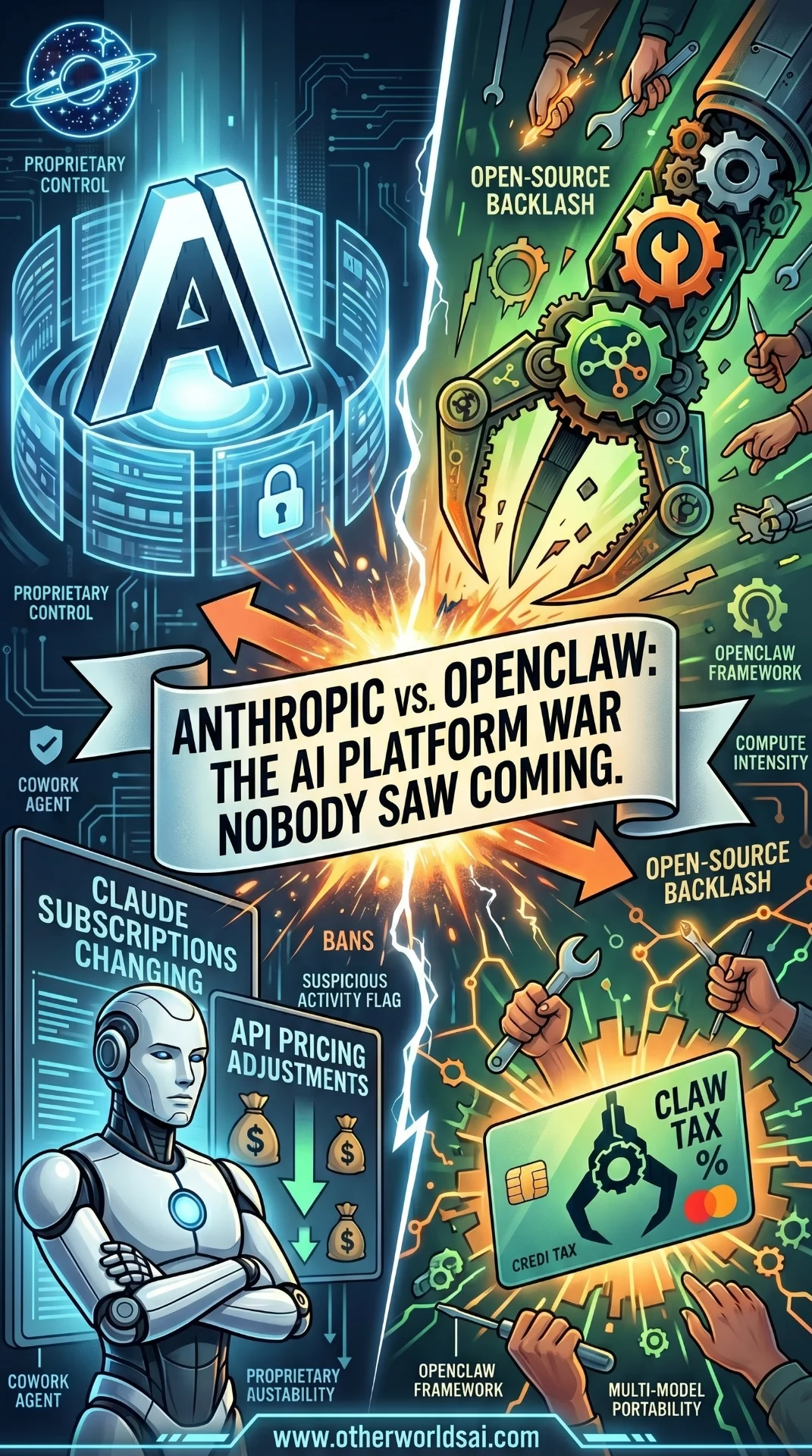
To understand why this ban generated such an outsized reaction, you need to understand what happened just the week before. Anthropic announced a major change to its subscription model: Claude subscriptions would no longer cover usage through third-party AI agent harnesses, explicitly calling out OpenClaw as an affected platform.
Users who want to continue running OpenClaw with Claude models now need to pay separately through the Claude API, based on actual consumption — what the developer community quickly dubbed a "claw tax."
Anthropic's justification for the pricing change centers on compute intensity. According to the company, its subscription plans were not designed to handle the unique "usage patterns" of AI agents like those built with OpenClaw. Unlike a typical chat prompt, AI claws — the autonomous agent workflows at the heart of OpenClaw — can run continuous reasoning loops, automatically retry or repeat tasks, and integrate with dozens of third-party tools simultaneously. This makes them significantly more resource-intensive than standard Claude usage.
Open Source vs. Closed Platform: Steinberger's Accusations:
Steinberger did not hold back in expressing his frustration with the timing of Anthropic's policy changes. After the subscription changes were announced, he posted pointedly on X: "Funny how timings match up, first they copy some popular features into their closed harness, then they lock out open source." While he did not name specific features, many in the community interpreted this as a reference to Anthropic's Cowork agent — Anthropic's own competing AI automation platform — and specifically to Claude Dispatch.
Claude Dispatch, a feature that lets users remotely assign tasks and control AI agents, was rolled out just a couple of weeks before Anthropic's new OpenClaw pricing policy took effect. The close timing between a competitive product feature launch and a policy that financially disadvantages an open-source alternative raised eyebrows across the AI developer community, sparking debates about fair competition in the rapidly evolving AI agent space.
The OpenAI Connection: Conflict of Interest or Developer Advocacy?
The fact that Steinberger now works at OpenAI — Anthropic's most direct rival — added a layer of complexity and conspiracy theory fodder to the situation. Hundreds of commenters weighed in, with some questioning why he was using Claude at all, and others insinuating that the suspension was politically motivated given his employer. One commenter went as far as suggesting Steinberger brought the trouble on himself by choosing OpenAI over Anthropic, to which he reportedly replied: "One welcomed me, one sent legal threats."
Steinberger was careful to separate his two roles. When asked why he continues to use Claude, he explained that his work with the OpenClaw Foundation is entirely distinct from his day job: "You need to separate two things.
My work at the OpenClaw Foundation where we wanna make OpenClaw work great for any model provider, and my job at OpenAI to help them with future product strategy." He uses Claude specifically for compatibility testing, to ensure that updates to OpenClaw won't break the experience for the large segment of OpenClaw users who prefer Claude over ChatGPT.
What This Means for the AI Developer Ecosystem:
The OpenClaw-Anthropic incident is more than a spat between two companies — it signals a broader inflection point in how AI model providers are thinking about their platform economics. As large language models become infrastructure, questions around who gets access, at what price, and under what conditions are becoming critical for every developer building on top of AI APIs. The "claw tax" may be just the beginning of tiered pricing strategies that distinguish between lightweight users and power users running complex agent workflows.
For open-source AI developers, the message is clear: build dependency on any single model provider at your own risk. Steinberger's comment about "working on" improving ChatGPT compatibility for OpenClaw users is a strong signal that multi-model support and portability will become defining features of serious AI agent frameworks going forward. The AI community is watching closely to see how Anthropic responds — and whether other model providers follow suit with similar pricing strategies.
Key Takeaways: Claude API Pricing, OpenClaw, and the Future of AI Agents:
Here is a summary of the key developments in this story:
-
🔒 Anthropic temporarily suspended OpenClaw creator Peter Steinberger's account over flagged "suspicious" activity — the ban was lifted within hours after the post went viral.
-
💰 Claude subscriptions no longer cover OpenClaw usage. Users must pay through the Claude API based on consumption.
-
⚙️ AI agent workflows are more compute-intensive than typical prompts, which Anthropic cites as justification for separate pricing.
-
🤝 Steinberger separates his OpenClaw Foundation work from his OpenAI role, and continues testing Claude for compatibility purposes.
-
🚀 Multi-model portability is emerging as a priority for serious AI agent framework developers.
Support our research
Independent analysis fueled by you.