
The artificial intelligence industry may be on the verge of another historic funding milestone.
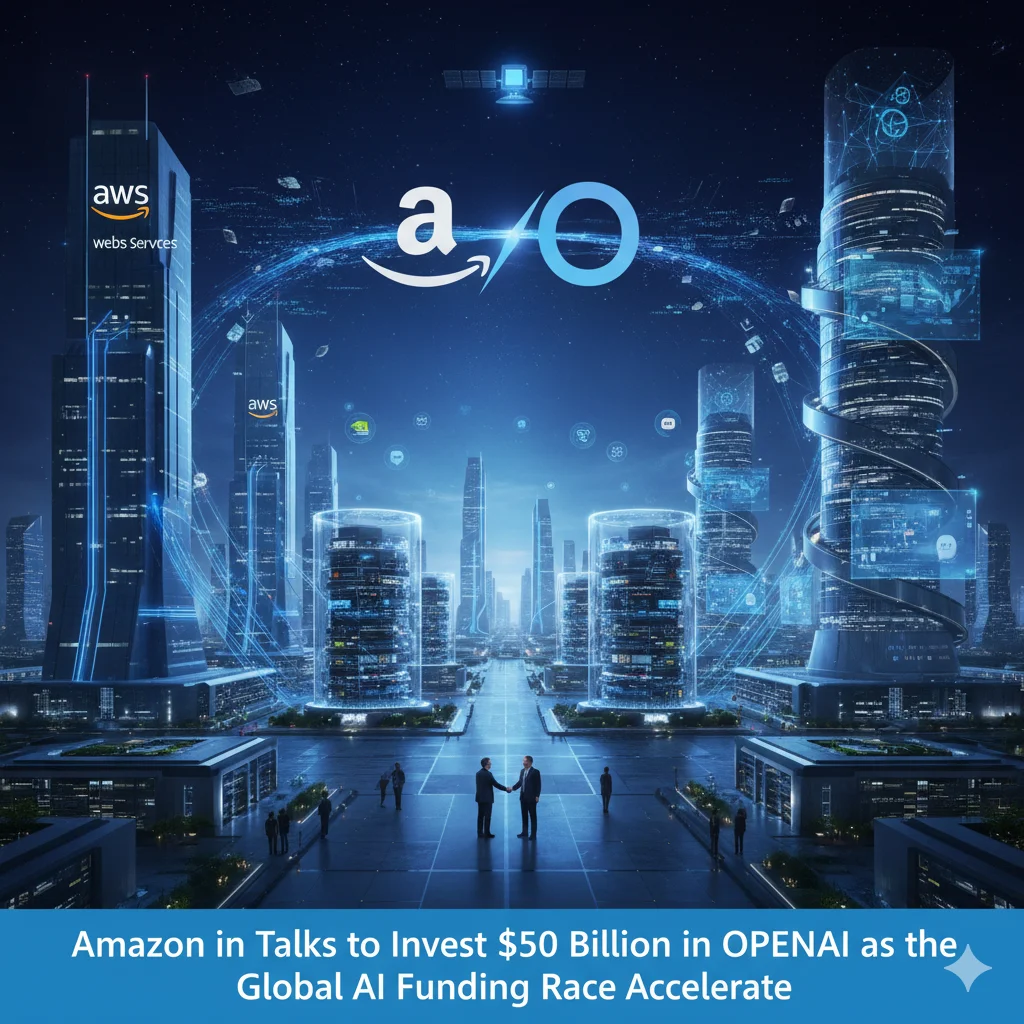
OpenAI, already one of the most valuable private companies in the world, is reportedly in discussions to raise an additional $100 billion in fresh capital—a move that could push its valuation to an astonishing $830 billion. According to The Wall Street Journal, Amazon is now in talks to contribute at least $50 billion to this record-breaking investment round.
If finalized, the deal would represent one of the largest single investments in AI history, further underscoring how central generative AI has become to the future of cloud computing, enterprise software, and consumer technology.
OpenAI’s Rapidly Expanding Valuation:
OpenAI is currently estimated to be valued at around $500 billion, reflecting explosive growth driven by the widespread adoption of ChatGPT, GPT-powered enterprise tools, and developer APIs.
The company’s ambition to raise another $100 billion highlights the enormous capital requirements of building and scaling frontier AI models, which demand massive investments in compute infrastructure, data centers, and specialized AI chips.
Should OpenAI successfully close the round at its target valuation, it would place the company among the most valuable private enterprises ever created, rivaling the market capitalizations of some of the world’s largest public corporations.
Amazon’s Role in the Negotiations:
According to the Wall Street Journal, Amazon CEO Andy Jassy is personally leading discussions with OpenAI CEO Sam Altman, signaling how strategically important the potential investment is for Amazon. While details of the deal remain scarce, both Amazon and OpenAI have declined to publicly comment on the ongoing talks.
For Amazon, such a large investment would align with its broader push to dominate AI infrastructure and cloud services through Amazon Web Services (AWS). OpenAI’s growing demand for compute power makes it a highly attractive partner for any cloud provider seeking long-term, high-volume AI workloads.
Middle East Sovereign Funds and Other AI Giants in the Mix:
Amazon is not the only player interested in backing OpenAI’s next phase of growth. Reports indicate that OpenAI has also been holding discussions with sovereign wealth funds in the Middle East, which have become increasingly active investors in artificial intelligence and advanced technology.
Additionally,The New York Times has reported that OpenAI has engaged in talks with several major industry players, including:
-
Nvidia, the dominant supplier of AI GPUs.
-
Microsoft, OpenAI’s long-time strategic partner.
-
SoftBank, which has recently renewed its aggressive investment strategy in AI and robotics.
The funding round is reportedly expected to close by the end of Q1, assuming negotiations proceed as planned.
The Anthropic Factor: A Strategic Twist:
What makes a potential Amazon–OpenAI partnership particularly intriguing is Amazon’s deep financial and operational relationship with Anthropic, one of OpenAI’s most prominent competitors.
Amazon has invested at least $8 billion in Anthropic and has designated AWS as Anthropic’s primary cloud and AI training provider. In a major show of commitment, Amazon recently opened an $11 billion data center campus in Indiana, built specifically to run Anthropic’s AI models at scale.
This raises important questions about how Amazon might balance its interests between two rival AI labs. If Amazon were to invest heavily in OpenAI while continuing to support Anthropic, it could position itself as a neutral infrastructure backbone for the entire AI ecosystem—profiting regardless of which model provider ultimately leads the market.
Why OpenAI Needs So Much Capital:
The sheer scale of OpenAI’s funding ambitions reflects the realities of next-generation AI development.Training frontier models requires:
-
Tens of thousands of advanced GPUs.
-
Custom AI accelerators.
-
Global-scale data centers.
-
Massive energy and cooling resources.
Beyond training, OpenAI is also investing heavily in:
-
Enterprise AI solutions.
-
Consumer products.
-
AI safety and alignment research.
-
Custom hardware initiatives.
Securing $100 billion in new funding would give OpenAI the runway needed to maintain its leadership amid intensifying competition from Google DeepMind, Anthropic, Meta, and emerging open-source AI players.
Implications for the AI Industry:
If Amazon commits $50 billion to OpenAI, the deal could reshape the competitive dynamics of the AI sector. Potential outcomes include:
-
Increased competition among cloud providers for AI workloads.
-
Further consolidation of power among a handful of well-funded AI labs.
-
Accelerated deployment of AI across enterprise and consumer applications.
-
Heightened regulatory and antitrust scrutiny.
The move would also reinforce the idea that AI infrastructure is becoming as strategically important as oil, electricity, or telecommunications in previous eras.
Final Thoughts:
Amazon’s reported talks to invest $50 billion in OpenAI highlight just how high the stakes have become in the global AI race. With OpenAI seeking a valuation of $830 billion, and major players like Amazon, Microsoft, Nvidia, and sovereign wealth funds circling, the next few months could define the future structure of the AI industry.
Whether or not the deal ultimately materializes, one thing is clear: the era of trillion-dollar AI ambitions has arrived, and the companies that control the infrastructure, capital, and talent will shape the technological landscape for decades to come.
Support our research
Independent analysis fueled by you.