
Anthropic Wins Federal Injunction Against Trump Administration: A Landmark Victory for AI Rights and Free Speech:
Overview: A Historic Ruling That Reshapes AI Governance in America:
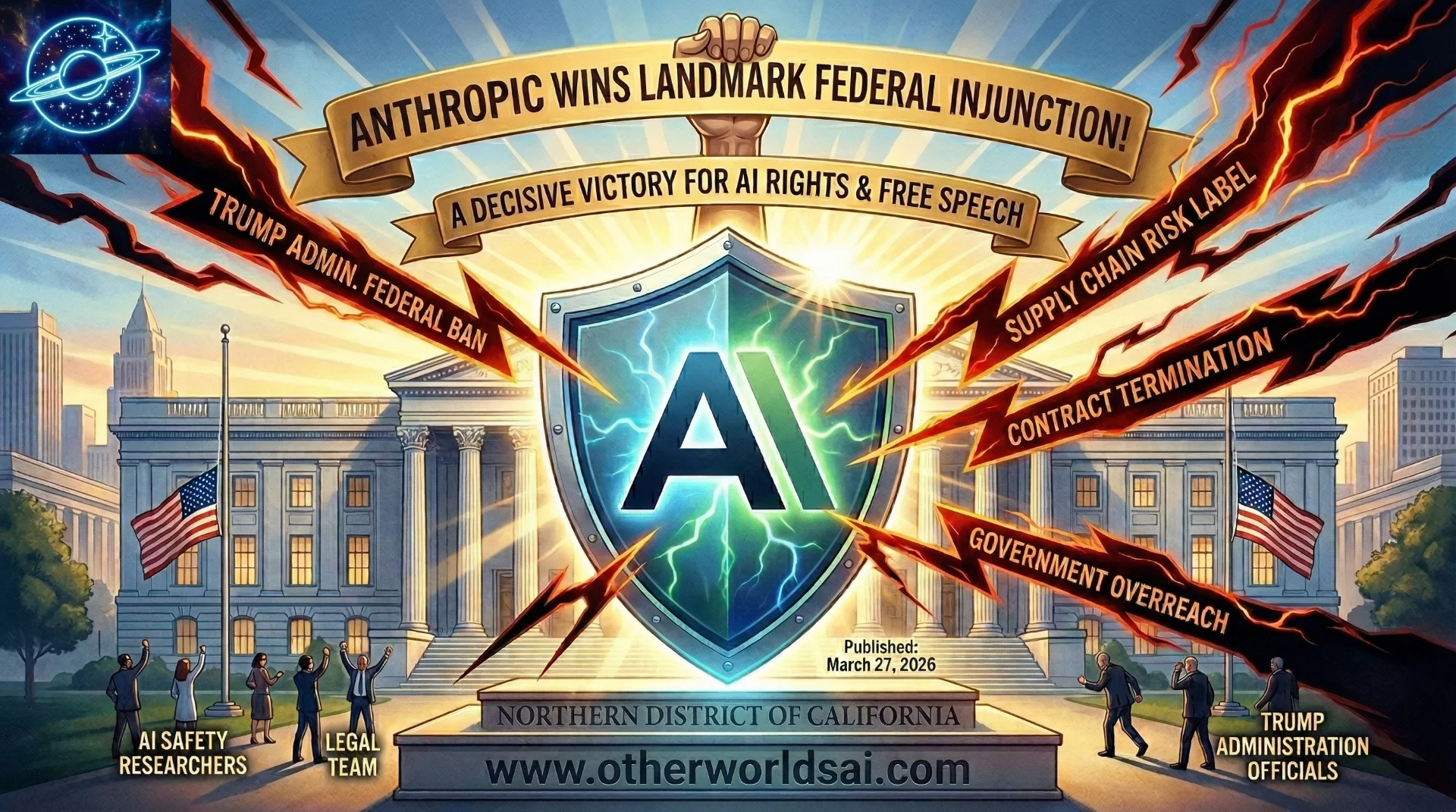
In a decisive legal victory that will reverberate across the artificial intelligence industry, federal Judge Rita F. Lin of the Northern District of California has issued a landmark injunction in favor of Anthropic, one of the world's leading AI safety companies. The ruling orders the Trump administration to rescind its controversial designation of Anthropic as a "supply chain risk" — a label that had previously been reserved exclusively for foreign adversaries — and to walk back its directive instructing federal agencies to sever all ties with the company.
This case sits at the critical intersection of AI policy, national security, and constitutional free speech protections, and its outcome sets a powerful precedent for how AI companies can push back against government overreach. For anyone following the future of AI regulation in the United States, this ruling is essential reading.
Background: How Did Anthropic Become a 'Supply Chain Risk'?
The roots of this legal dispute stretch back to a fundamental disagreement over the ethical boundaries of AI use by the U.S. government. Anthropic, the company behind the Claude family of AI models and a firm founded on the principles of responsible, safe AI development, had sought to impose specific usage restrictions on how federal agencies could deploy its technology.
Specifically, Anthropic attempted to prohibit the use of its AI models in autonomous weapons systems and mass surveillance programs. These are not fringe concerns — they represent core ethical commitments that AI safety researchers have long argued are essential to preventing catastrophic misuse of advanced AI. However, the Department of Defense and the broader Trump administration took exception to these restrictions, viewing them as an unacceptable constraint on government authority.
Rather than negotiating a compromise, the administration made a dramatic and unprecedented move: it labeled Anthropic a "supply chain risk" — a designation that carries serious national security implications and had, until now, been applied only to foreign actors or companies with direct ties to adversarial nations. This designation triggered orders for federal agencies to cut all contractual and operational ties with Anthropic, effectively freezing the company out of the lucrative federal AI market overnight.
The Legal Battle: Anthropic Fights Back in Federal Court:
Facing an existential threat to its government partnerships and its broader reputation in the AI market, Anthropic moved swiftly to challenge the designation through the courts. The company filed suit against the Department of Defense and Defense Secretary Pete Hegseth, arguing that the government's actions were not only legally improper but constitutionally indefensible.
Anthropic's legal team mounted a two-pronged argument:
first, that the supply chain risk designation was factually and legally unwarranted for a domestic AI company operating transparently within the United States;
Second, that the administration's actions amounted to unconstitutional retaliation against Anthropic for its speech — specifically, for publicly advocating for responsible AI use policies that the government happened to disagree with.
The Judge's Ruling: Free Speech Protections and a Strong Rebuke:
Judge Lin's ruling was unequivocal and striking in its directness. During court proceedings, the judge did not mince words about the nature of the government's actions, reportedly stating that
"It looks like an attempt to cripple Anthropic."
This framing — that a federal judge viewed the administration's actions as a deliberate effort to destroy a private AI company — is extraordinary in its implications. Lin ultimately grounded her injunction in First Amendment free speech protections, ruling that the government's orders had violated Anthropic's constitutional rights.
The injunction requires the administration to rescind both the supply chain risk label and the directive ordering agencies to terminate their relationships with Anthropic. The court's language signals that Anthropic is likely to succeed on the merits when the full case proceeds, a finding that adds significant legal weight to the injunction and puts the Trump administration on the defensive as litigation continues.
White House Attacks and CEO Response: The Political Dimension:
The legal battle has unfolded against a backdrop of escalating political rhetoric targeting Anthropic and its leadership. The White House spent recent weeks openly attacking the company in extraordinarily charged terms, characterizing Anthropic as "a radical-left, woke company" that is actively jeopardizing America's national security interests by imposing ideological restrictions on government AI use.\

Move Over Nvidia: Anthropic and Samsung Team Up to Break the AI Chip Monopoly
Anthropic CEO Dario Amodei pushed back forcefully, describing the Defense Department's actions in stark terms. Amodei called the government's conduct "retaliatory and punitive" — language that aligns precisely with the legal theory Anthropic advanced in court.
This dynamic — a tech CEO publicly characterizing government actions as retaliatory, and a federal judge appearing to agree — represents an unprecedented moment in the evolving relationship between Silicon Valley and Washington. It raises critical questions about the boundaries of government power over private AI companies, and what happens when those companies attempt to impose ethical guardrails that conflict with state priorities.
Anthropic's Statement: Gratitude, Resolve, and a Commitment to Collaboration:
Following Judge Lin's ruling, Anthropic issued a carefully crafted public statement that balanced legal triumph with a forward-looking posture toward government collaboration. The company expressed gratitude to the court for moving quickly and signaled confidence in the ultimate outcome of the litigation:
"We're grateful to the court for moving swiftly, and pleased they agree Anthropic is likely to succeed on the merits. While this case was necessary to protect Anthropic, our customers, and our partners, our focus remains on working productively with the government to ensure all Americans benefit from safe, reliable AI."
This statement is strategically notable: even in victory, Anthropic is careful not to position itself as an adversary of the federal government. The company frames the lawsuit as a defensive necessity rather than an offensive strike, and pivots immediately to its desire for productive collaboration. This tone is deliberate — Anthropic needs government contracts, and it clearly does not want this legal victory to permanently poison the well for future federal partnerships.
Why This Ruling Matters for the AI Industry: Precedent, Policy, and Power:
The Anthropic injunction is far more than a single company's legal victory — it establishes critical precedent for the entire AI industry. For the first time, a federal court has ruled that the government cannot weaponize national security designations to coerce AI companies into abandoning their ethical usage policies. This is a significant check on executive power in the AI space.
For AI companies navigating the complex terrain of government contracts and regulatory compliance, this ruling sends a clear message: advocating for responsible AI use policies is constitutionally protected speech, and retaliatory government action in response to such advocacy is subject to legal challenge. Companies can now point to Judge Lin's ruling as a precedent when pushing back against overreaching government directives.
The case also highlights the deepening tension between AI safety priorities and national security applications of AI. As AI systems become more powerful and more embedded in government operations, disputes over the ethical limits of government AI use are only likely to intensify. The question of who controls those limits — the companies building the technology, the government deploying it, or the courts adjudicating disputes between them — has just gotten a great deal more interesting.
Conclusion: A Turning Point in the AI Governance Debate:
The federal injunction won by Anthropic against the Trump administration marks a turning point in the evolving legal and political landscape of AI governance in the United States. A federal judge has affirmed that AI companies have constitutional protections when advocating for responsible use of their technology — and that the government cannot simply label a domestic company a national security threat to silence or marginalize it.
As litigation continues and the broader policy debate over AI regulation unfolds, this ruling will serve as a foundational reference point. For Anthropic, for the AI industry, and for the future of AI policy in America, the implications of Judge Lin's decision are profound and far-reaching.
The conversation about who gets to set the rules for AI — and what happens when government and technology companies disagree — is now very much alive in the federal courts.
Support our research
Independent analysis fueled by you.