
AI Film Restoration Breakthrough: How Generative AI Is Recreating Orson Welles' Lost Masterpiece in 2025:
Can Artificial Intelligence Resurrect Orson Welles' Lost Masterpiece?
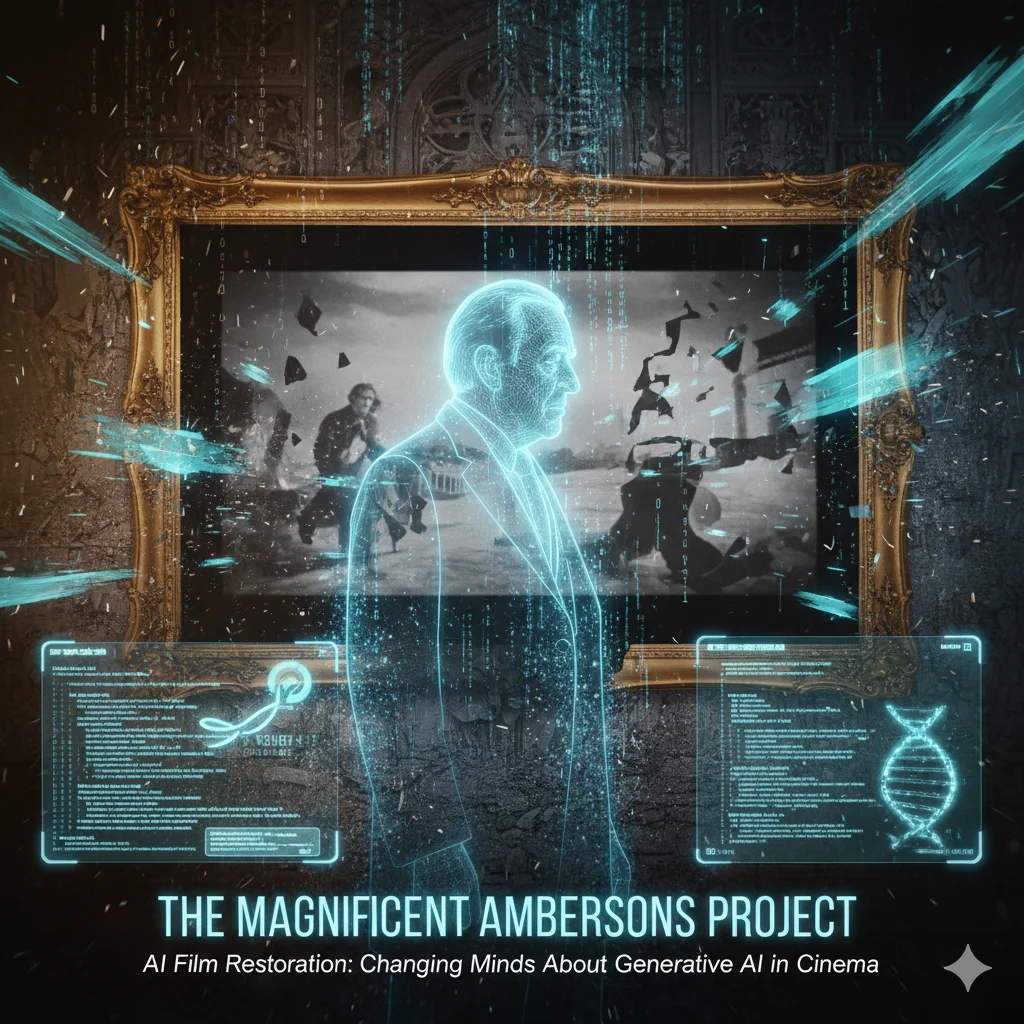
When news broke last fall about a tech startup planning to recreate lost footage from Orson Welles' legendary film "The Magnificent Ambersons" using generative AI technology, the film community erupted with skepticism. As someone who initially questioned this AI film restoration project, I'll admit: my perspective is evolving. Here's why this controversial use of artificial intelligence in cinema might deserve a second look.
The Magnificent Ambersons: Hollywood's Most Heartbreaking Lost Film:
Before diving into the AI controversy, let's understand what makes "The Magnificent Ambersons" so special in cinema history. While "Citizen Kane" remains Orson Welles' most famous work, the legendary director himself claimed "Ambersons" was "a much better picture." That's a bold statement about a film most audiences have never truly seen.
The tragic backstory reads like a Hollywood nightmare: after a disastrous preview screening, studio executives took drastic action. They slashed 43 minutes from Welles' original vision, tacked on an unconvincing happy ending, and committed the ultimate sin—they destroyed the excised footage to free up vault space. Gone forever. Or so we thought.
Enter Fable Studio: When AI Meets Classic Cinema:
This is where Edward Saatchi and his startup Fable enter the picture. According to an in-depth New Yorker profile by Michael Schulman, this isn't just another tech bro venture into creative disruption. Saatchi's motivation stems from genuine cinematic passion.
The founder—son of advertising legend Maurice Saatchi of Saatchi & Saatchi—grew up in a film-obsessed household, watching classics in a private screening room. He first encountered "The Magnificent Ambersons" at age twelve, and the incomplete masterpiece left an indelible mark.
"To me, this is the holy grail of lost cinema," Saatchi explained. "It just seemed intuitively that there would be some way to undo what had happened."
AI Film Technology: How the Restoration Actually Works:
Fable's approach to this AI-powered film restoration combines cutting-edge technology with traditional filmmaking:
-
Live-Action Filming: Actors perform scenes based on Welles' original script and production notes.
-
Digital Recreation: AI technology overlays footage with digital recreations of the original actors.
-
Voice Synthesis: Artificial intelligence recreates the voices of actors like Joseph Cotten.
-
Cinematography Matching: Complex algorithms attempt to replicate the film's distinctive visual style.
But this technology isn't without significant challenges. The company has encountered problems ranging from obvious glitches—like generating a two-headed Joseph Cotten—to more subtle issues. Saatchi even mentioned a "happiness problem," where the AI incorrectly made female characters appear too cheerful, undermining the film's dramatic tone.
Not the First Attempt: Brian Rose's Animated Vision:
Saatchi isn't the first Welles devotee to dream of completing "The Magnificent Ambersons." Filmmaker Brian Rose spent years creating animated scenes based on the script, photographs, and Welles' detailed notes. When Rose screened his version for friends and family, he admitted "a lot of them were scratching their heads."
Fable is now collaborating with Rose, essentially creating a better-funded, technologically advanced version of his labor of love. This partnership positions the project less as corporate exploitation and more as passionate fan restoration.
Legal Challenges and Estate Approval for AI Recreation:
The road to releasing this AI-generated footage faces significant obstacles. Saatchi conceded it was "a total mistake" not to consult Welles' estate before the initial announcement—a rookie error that could have derailed everything.
Since then, he's worked to win approval from:
-
Beatrice Welles (Orson's daughter): Initially skeptical, she now believes the team approaches the project "with enormous respect toward my father and this beautiful movie."
-
Warner Bros.: The studio owns the film rights and must approve any release.
-
Simon Callow: The acclaimed actor and Welles biographer (currently writing the fourth volume of his comprehensive biography) has agreed to advise, calling it a "great idea."
The Artistic Objection: Why Some Say AI Can't Capture Cinema's Soul:
Not everyone is convinced this AI film restoration represents progress. Melissa Galt, daughter of "Magnificent Ambersons" actress Anne Baxter, offered a powerful counterargument:
"It's not the truth. It's a creation of someone else's truth. But it's not the original, and she was a purist... once the movie was done, it was done."
This perspective aligns with a broader philosophical critique of AI in art. Writer Aaron Bady recently compared AI to vampires, arguing that both miss what makes art meaningful: mortality and limitations.
"There is no work of art without an ending, without the point at which the work ends," Bady wrote. "Without death, without loss, and without the space between my body and yours, separating my memories from yours, we cannot make art or desire or feeling."
The Uncomfortable Truth About Accepting Loss in Cinema:
Viewed through this lens, Saatchi's insistence that there must be "some way to undo what had happened" reveals something almost childish—an unwillingness to accept that some losses are permanent and perhaps even meaningful.
It's not unlike tech founders claiming they can eliminate grief through digital immortality, or those studio executives who insisted "The Magnificent Ambersons" needed a happy ending in the first place. Both refuse to accept the reality of endings.
My Changing Perspective on AI in Film Restoration:
Despite these valid concerns, I find myself more sympathetic to Saatchi's aims than when this project first launched. Here's why:
-
The genuine love: This isn't corporate IP exploitation—it's fan devotion backed by resources.
-
The collaboration: Working with Brian Rose and consulting experts shows respect for the source.
-
The transparency: Fable hasn't hidden the technical challenges or artistic compromises.
-
The intent: This aims to offer a glimpse of Welles' vision, not replace the original.
What This Means for the Future of AI in Cinema:
The Magnificent Ambersons AI restoration project represents a fascinating test case for artificial intelligence in film preservation and restoration. It raises questions that will only become more pressing:
-
Can AI ethically recreate lost art?
-
Should technological possibility override artistic intent?
-
Where's the line between restoration and creation?
-
Do deceased artists' estates have final say over AI recreations?
The Bottom Line: A Beautiful Novelty, Nothing More:
Even with my newfound sympathy for this project, I agree with Anne Baxter's daughter: at its absolute best, this AI-generated footage will only produce a novelty—a dream of what the movie might have been, not what it was.
And perhaps that's okay. Perhaps there's value in the dream itself, in the attempt to honor Welles' vision even if we can never truly capture it. The key is remembering that this AI creation, however sophisticated, remains a loving tribute, not a resurrection.
The original Magnificent Ambersons—the version Orson Welles actually made—is gone. No amount of machine learning, neural networks, or generative AI can change that fundamental loss. But maybe, just maybe, this technological homage can help us understand what we lost and why it mattered.
That's not nothing. It's just not everything Saatchi hopes it might be.
What do you think? Should AI be used to recreate lost films, or does the technology cross an artistic line? Share your thoughts on this controversial intersection of classic cinema and cutting-edge technology.
Support our research
Independent analysis fueled by you.