
Lake Tahoe Power Crisis 2027: How AI Data Centers Are Driving a Regional Energy Crunch:
A 40,000-Acre Utah Data Center Project Is Shaking Up the Western Grid.
The clock is ticking for Lake Tahoe's energy future. By May 2027, one of California's most beloved mountain retreats will be left without a power supplier — and the ripple effects of the artificial intelligence energy boom are largely to blame. As AI data centers across the American West consume electricity at an unprecedented scale, traditional communities like Lake Tahoe are being squeezed out of the energy market, facing higher costs, strained supply chains, and an uncertain road ahead.
The Liberty Utilities–NV Energy Contract: What's Happening and Why It Matters:
A decades-long energy agreement is coming to an end, and the timing couldn't be more consequential. Liberty Utilities, the primary electricity provider for the Lake Tahoe region, currently sources its power from NV Energy through a contract set to expire in May 2027. Once that agreement lapses, NV Energy's electricity will be redirected to serve Nevada's booming demand — demand that is overwhelmingly driven by hyperscale AI data centers flocking to the Silver State.
Both utilities have publicly maintained that this wind-down was long planned. NV Energy has specifically stated that data centers are not to blame for the contract's end. But the numbers tell a more complicated story. NV Energy alone is currently fielding requests for more than 22 gigawatts of new load — a staggering figure that is more than 40 times what Lake Tahoe consumes at peak demand. When a single utility is managing that volume of new AI-driven requests, it is nearly impossible to argue that traditional residential customers are not feeling the pressure.
AI Data Centers and the Western Energy Grid: A Growing Collision:
The artificial intelligence infrastructure buildout is reshaping America's energy landscape at a speed that regulators and utilities were not prepared for. Hyperscalers — the mega-tech companies behind cloud computing and large language models — have historically avoided the Bay Area due to sky-high land and power costs, pushing their data center projects to Nevada, Arizona, and Texas instead.That geographic shift is now creating downstream power crunches for neighboring communities that share grid infrastructure.
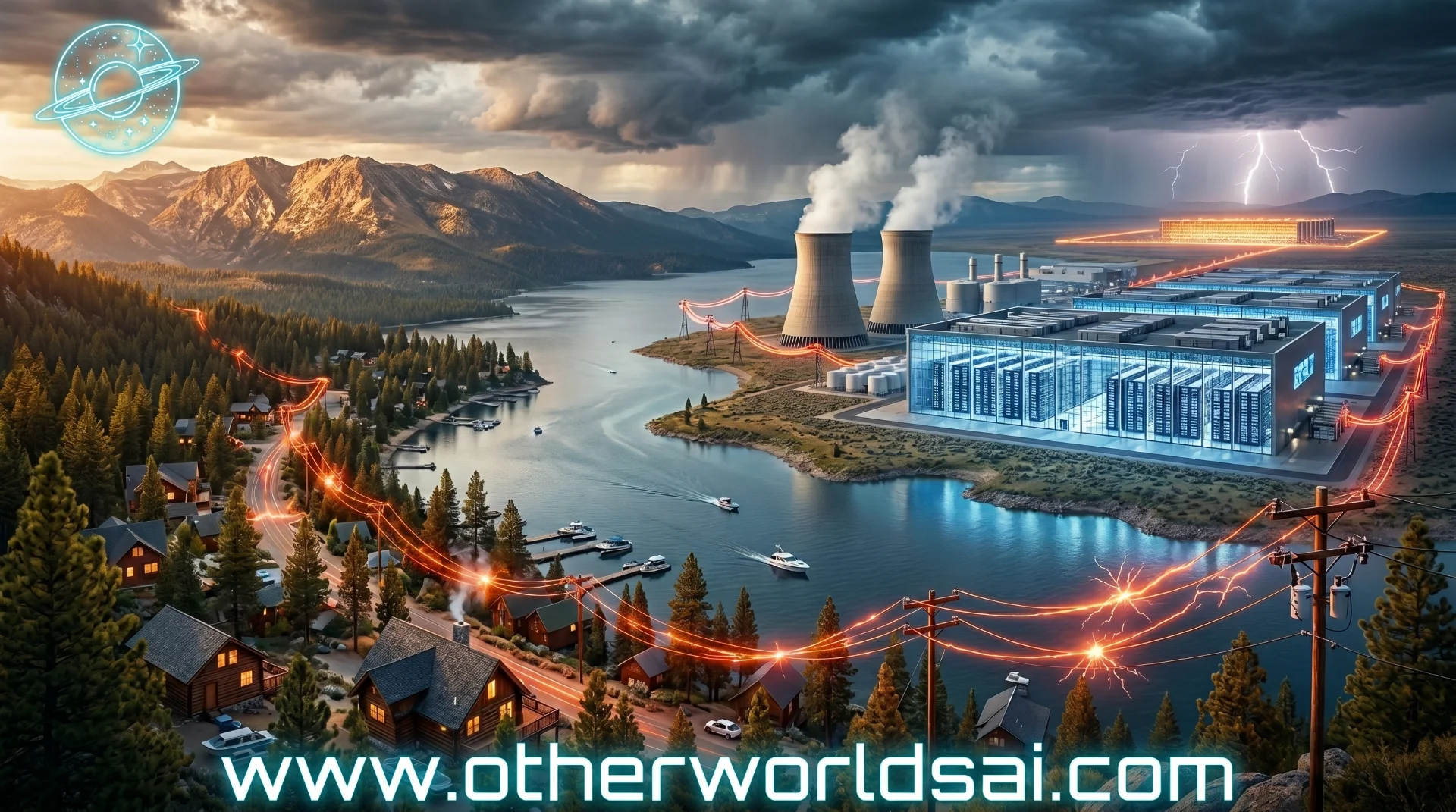
Lake Tahoe's predicament is particularly acute because of how its grid is wired. The region's power lines are more deeply connected to Nevada's grid than to California's, meaning that Lake Tahoe cannot simply tap into PG&E or other California providers without significant infrastructure upgrades. The community must find a new supplier from within NV Energy's service territory or elsewhere in the broader Western Interconnection — at a time when every available megawatt is being snapped up by AI operators willing to pay a premium.
Utah's 40,000-Acre Data Center Project: Regional Prices Are About to Surge:
The energy pressure on Lake Tahoe doesn't stop at the Nevada border. Just one state over, a county commission in Utah recently approved a massive 40,000-acre data center development — one of the largest in American history — that could consume up to 9 gigawatts of electricity when fully built out. For context, the entire state of Utah currently uses approximately 4 gigawatts. A single project that could double a state's electricity consumption will inevitably push wholesale power prices upward across the entire Western grid.
Regional electricity markets are deeply interconnected, and price shocks travel fast. When demand spikes in Utah, power prices rise in Nevada. When Nevada's grid is stressed, suppliers in neighboring states see their rates increase. Lake Tahoe sits at the intersection of these pressure points, making it one of the most exposed communities in the West to the cascading costs of AI-driven power demand.
Energy Market Volatility in 2026–2027: A Perfect Storm for Rate Increases:
Lake Tahoe is not facing its power crisis in a stable market — quite the opposite. Energy markets across the United States are already under severe strain in 2026, squeezed by surging demand from electrification, extreme weather events, and tightened global supply chains. Compounding these pressures, the Trump administration's decision to pursue military action against Iran has injected significant volatility into global energy markets, driving up costs for natural gas and petroleum-derived electricity generation.
The confluence of these macro-level factors and Lake Tahoe's hyper-local supply problem creates a worst-case scenario for ratepayers. When Liberty Utilities enters contract negotiations with a new energy provider — likely sometime in late 2026 — it will be negotiating from a position of weakness in a seller's market. The result, almost certainly, will be electricity rates that are meaningfully higher than what Lake Tahoe residents and property owners pay today.
Who Bears the Cost? Locals, Second-Home Owners, and the Silicon Valley Connection:
The irony of Lake Tahoe's energy crisis is not lost on observers of the tech industry. Lake Tahoe has long served as the vacationland of Silicon Valley's elite — a mountain retreat where founders, venture capitalists, and engineers escape the pressures of the Bay Area. Many of the second homes dotting the shores of the lake are owned by the same people who fund, build, and deploy the AI systems now straining the grid. They will feel the pinch of higher electricity bills, but they can afford to absorb it.
For permanent residents, the story is far more serious. Year-round locals in Lake Tahoe — many of whom work in tourism, hospitality, and outdoor recreation — do not have the financial cushion of tech millionaires. Rising electricity costs hit their household budgets directly, and unlike data center operators who can negotiate custom power purchase agreements, individual ratepayers have little leverage in energy markets. This is the defining injustice of the AI energy crunch: the communities bearing the cost are not the communities driving the demand.
What Comes Next: Possible Solutions and Long-Term Outlook:
Finding a new power supplier for Lake Tahoe before May 2027 will require urgent action from state regulators, Liberty Utilities, and California and Nevada policymakers. Several paths are theoretically available: negotiating a new long-term contract with a regional utility, developing local renewable energy generation (solar and battery storage are particularly promising in the Sierra Nevada), or pursuing interconnection upgrades that would give the community better access to California's grid. Each option carries significant costs and lead times that may not be achievable within the current window.
The broader policy question is whether AI data center expansion should face greater scrutiny over its grid impacts. State utility commissions in Nevada, California, and Utah are beginning to grapple with how to balance economic development goals — data centers bring jobs and tax revenue — against grid stability and affordability for existing customers. The Lake Tahoe situation is likely to become a case study in what happens when that balance is not struck early enough.
Key Takeaways: The AI Energy Crunch Is Now a Mainstream Issue:
For years, the energy demands of artificial intelligence were an abstract concern debated in policy circles and technology conferences. Lake Tahoe's power crisis makes the stakes viscerally real. A beloved American community is facing higher electricity bills and supply uncertainty not because of anything its residents did, but because of decisions made in corporate boardrooms and data center campuses hundreds of miles away.
The situation underscores three critical realities about the AI energy transition: First, the Western grid is not infinitely elastic — there are real limits to how much new load it can absorb without displacing existing customers. Second, communities with weaker grid connections and smaller political constituencies are disproportionately vulnerable to being squeezed out. Third, the people who have the least say in how AI is deployed are often the ones who pay the highest price for it.
Lake Tahoe has less than a year to find a solution. The rest of the country has slightly more time to decide whether this is the model it wants to follow —
or whether smarter energy planning, fairer utility regulation, and more accountable AI infrastructure development can chart a different course.
Energy Crisis | AI Infrastructure | Data Center Power Demand | Utility Planning
Support our research
Independent analysis fueled by you.